Perry Design Review: Farr 40
Fun, easy-to-sail racer with a lot of horsepower
September 13, 2000
I find myself frequently explaining to people what the IMS was. The biggest area of interest for big-boat sailors today is the advent of some exciting one-design racers. The Mumm 30, Reichel/Pugh's One Design 48, and the Corel 45 have all developed very strong racing programs and fleet support systems.

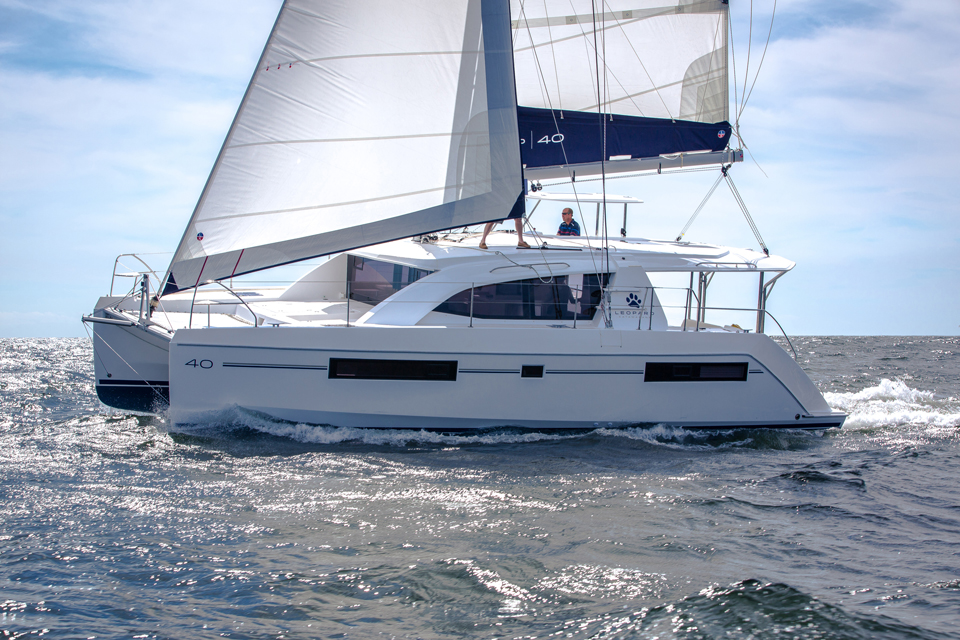
A Farr 40 powers upwind.
From the owner's point of view, development classes are an expensive game. The boat that dominates one series may find itself legislated out of competitiveness by a committee during the off-season. It's very scary for owners to commit to new designs when the rules are not stable.
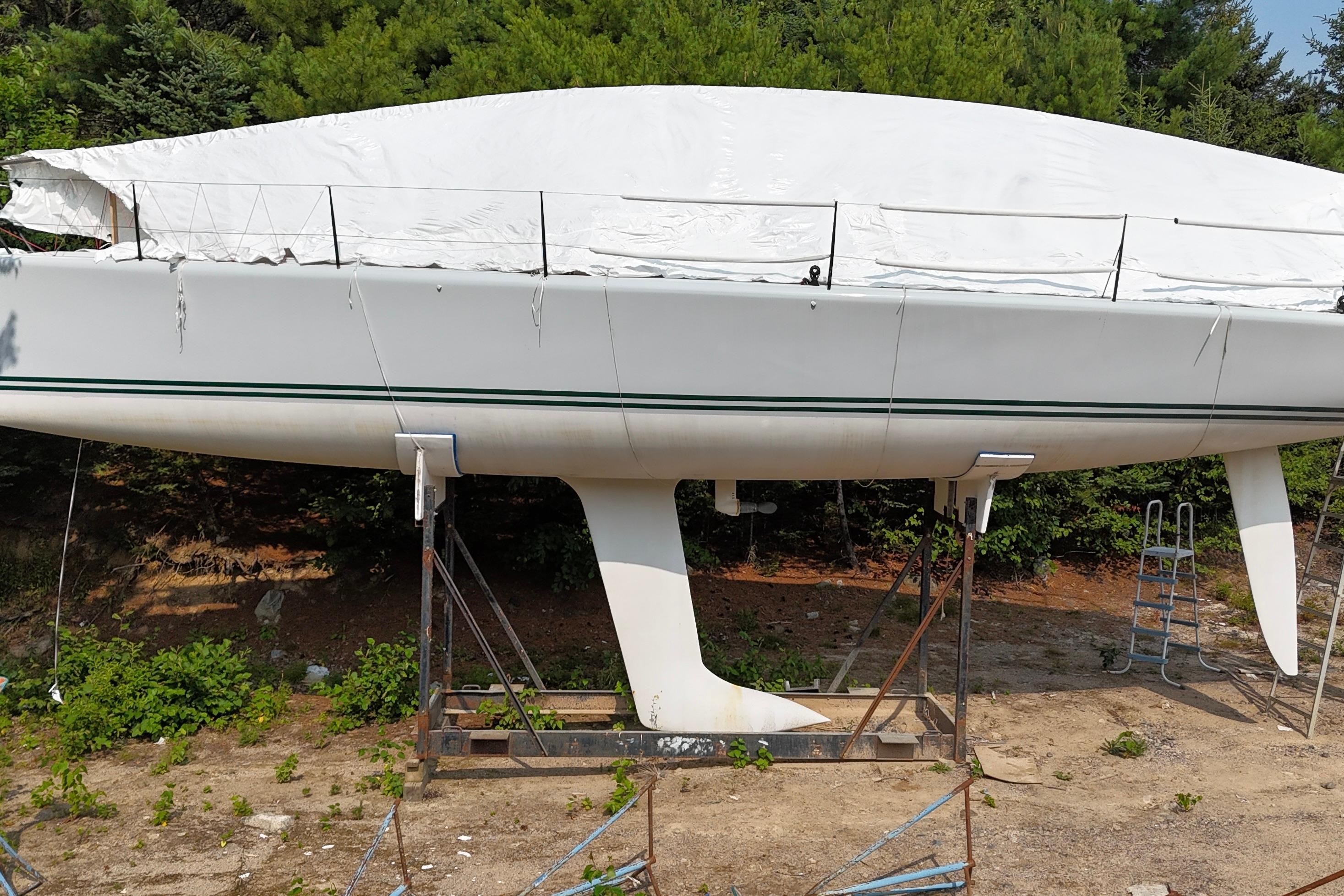
The Bruce Farr office designed this 40 to fill the gap between the Mumm 30 and the Corel 45. The D/L is 110 and the ballast-to-displacement ratio is 47 percent. Draft is 8 feet 6 inches; note the size of the bulb on the fin. With super high-tech construction techniques and this amount of ballast, you can imagine how low the overall vertical center of gravity of the entire boat is. You can figure that your typical, generic American cruiser-racer has a VCG at or near the DWL. The Farr 40 probably has a VCG about 12 inches below the DWL. This translates to lots of sail carrying power. That's what it's all about, i.e. horsepower per pound in a manageable package.
Construction of the 40 includes epoxy, E-glass, foam composite and wet pre-preg fabrics. The entire hull and deck are post-cured in an oven. The keel is a steel fin with a lead bulb coated in epoxy. There is a Yanmar 30-horsepower diesel with a saildrive unit. Note that the engine is turned 180 degrees, putting the prop immediately aft of the keel. There are even 20 gallons of fuel and two water tanks at 21 gallons each.
The sail area-to-displacement ratio is 31:1. This is very high for a monohull and reflects the stability of the boat. The mast is carbon fiber with double, swept spreaders. The spreaders are swept to an angle of 20 degrees, measured at the chainplates. There are no runners. Note that the chainplates are almost at the rail, indicating that the jibs will sheet inside of the shrouds. The mainsail is loose footed, and the mainsheet leads aft under the deck in the European style. The jibs are nonoverlapping. Note the battens in the leech of the jib.
There is a rudimentary interior in this boat. The nav area is tucked under the cockpit sole; I have measured several times, and I can't see how there is even sitting headroom. The engine weight looks like it is precisely over the longitudinal center of buoyancy. The galley is miniscule. Okay, so it isn't a cruising boat.
On deck this boat is laid out with the knowledge that Farr has gained through the past 10 years of almost total domination of offshore racing events. Crew weight is pushed forward out of the stern. Most cruisers would be amazed at just how easy it is to sail a boat like this.
I'm sure this will be a wonderful boat. Barry Carroll's crew is as good as any and produces boats with wonderful finish detailing. The Farr 40 should be able to win in any fleet. I chuckled when I read the brochure, however. "PHRF performance will be stellar." Doesn't that depend upon the rating that is given to the boat? Of course we know that boats with a lot of boat speed tend to win more often.
Fun, easy-to-sail racer with a lot of horsepower.
Boat Specifications
Water42.24 gals. (in 2 tanks).
| LOA | 40'8" |
| LWL | 35'5" |
| Beam | 13' |
| Draft | 8'6" |
| Displacement | 10,960 lbs. |
| Ballast | 5,140 lbs. |
| Sail Area | 940 sq. ft. |
| SA/D | 31.1 |
| D/L | 110 |
| L/B | 3.13 |
| Auxiliary | Yanmar 3GMSD30 27-horsepower diesel |
| Fuel | 19.8 gals. |
 This story originally appeared in Sailing Magazine, and is republished here by permission. Subscribe to Sailing.